You visit a website, enter your username and password, and click Login. The website looks completely normal, and everything appears to be working as expected.
But there's a problem: your connection might not actually be encrypted.
Most people recognize the HTTPS padlock symbol in their browser and associate it with security. HTTPS protects information exchanged between a browser and a website through encryption, helping prevent attackers from reading or modifying data in transit.
But what happens when an attacker finds a way to interfere with the process that establishes this secure connection?
This is where an SSL Stripping attack comes into play.
SSL stripping is a type of Man-in-the-Middle (MITM) attack that attempts to downgrade a user's connection from HTTPS to unencrypted HTTP. By doing this, an attacker may be able to intercept sensitive information that would otherwise be protected.
In this article, we'll explore what SSL stripping is, how it works, why HTTPS alone isn't always enough, and how website owners and users can defend against it.
1. First, What Are SSL and TLS?
Before understanding SSL stripping, we need to understand the technology that protects modern web communications.
SSL stands for Secure Sockets Layer. It was an early protocol developed to encrypt communications between clients and servers.
However, SSL has been deprecated because of security weaknesses. Its successor is Transport Layer Security (TLS).
Today, HTTPS uses TLS to secure communication between a browser and a web server.
TLS provides three important security properties:
- Confidentiality: Encrypts transmitted information so unauthorized parties cannot easily read it.
- Integrity: Helps ensure that transmitted information has not been secretly modified.
- Authentication: Allows the browser to verify the identity of the server through its digital certificate.
For example, when you visit an online banking website using HTTPS, TLS helps protect your login credentials and other sensitive information while they travel across the network.
So why do SSL stripping attacks still matter?
Because attackers may target the process of establishing a secure connection rather than directly breaking the encryption itself.
2. What Is an SSL Stripping Attack?
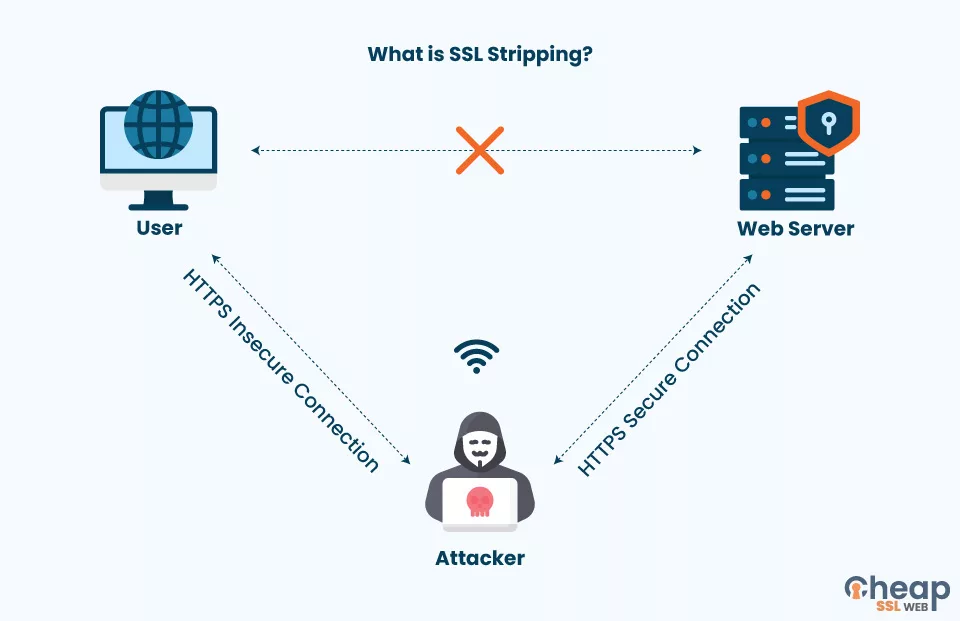
An SSL stripping attack is a type of man-in-the-middle attack in which an attacker attempts to prevent a connection from using HTTPS.
The attacker positions themselves between the victim and the website, intercepting and potentially modifying communications.
Instead of allowing the victim's browser to establish a secure HTTPS connection, the attacker attempts to keep the victim communicating over unencrypted HTTP.
The attacker may then maintain a separate HTTPS connection with the legitimate website.
This creates two different connections:
- Victim to attacker: HTTP (unencrypted).
- Attacker to legitimate website: HTTPS (encrypted).
The website may still receive encrypted traffic from the attacker, while the victim unknowingly communicates without encryption.
The dangerous part is that the attacker can potentially read or modify information passing through the unencrypted connection.
This can expose information such as login credentials, session information, and other sensitive data.
3. How Does an SSL Stripping Attack Happen?
Let's walk through a simplified example.
Imagine you're connected to public Wi-Fi at a coffee shop and want to access an online account.
You enter:
http://example.com
The website normally redirects visitors to:
https://example.com
This redirect is intended to move the browser from an unencrypted connection to an encrypted one.
However, an attacker who can intercept and modify the initial HTTP communication may interfere with this upgrade.
Here's how the attack can work:
Step 1: The victim connects to a network.
The victim connects to a network where an attacker has an opportunity to intercept traffic, such as a compromised or malicious Wi-Fi access point.
Step 2: The victim visits a website using HTTP.
The browser initially sends an unencrypted HTTP request to the website.
Step 3: The attacker intercepts the communication.
The attacker positions themselves between the victim and the legitimate website using a man-in-the-middle technique.
Step 4: The attacker interferes with the HTTPS upgrade.
The legitimate website attempts to redirect the browser to HTTPS. The attacker modifies the communication so the victim continues using HTTP instead.
Step 5: The attacker relays communication to the website.
The attacker can establish a separate HTTPS connection with the legitimate website, making the overall interaction appear to work normally.
Step 6: Sensitive information becomes exposed.
Because the victim's connection is unencrypted, information transmitted through that connection may be visible to the attacker.
The victim might never realize that the secure connection was downgraded.
4. Why Is SSL Stripping Dangerous?
The main danger is that users may believe their information is protected when it is actually being transmitted without encryption.
Consider a login page.
Under normal circumstances:
- Your browser establishes an HTTPS connection.
- Your credentials are encrypted before transmission.
- The server receives and processes your login information.
During a successful SSL stripping attack:
- The attacker interferes with the HTTPS upgrade.
- Your browser communicates with the attacker over HTTP.
- Your credentials may be exposed before the attacker forwards the request to the legitimate website.
This can lead to several consequences:
Credential theft: Attackers may capture usernames and passwords transmitted over an unencrypted connection.
Session hijacking: If session cookies or tokens are exposed, an attacker may be able to use them to impersonate an authenticated user.
Data manipulation: Without transport encryption and integrity protection, an attacker may modify information exchanged between the victim and the website.
Privacy violations: Information about a user's activity and the data they exchange may become visible.
SSL stripping is particularly concerning because the website itself might still be using HTTPS correctly. The weakness is in how the user's connection reaches it.
5. How Can SSL Stripping Attacks Be Prevented?
Fortunately, there are several defensive measures that make SSL stripping significantly more difficult.
A. HTTP Strict Transport Security (HSTS)
One of the most important defenses is HTTP Strict Transport Security (HSTS).
HSTS is a security policy communicated through an HTTP response header.
It tells a browser that a particular website should only be accessed using HTTPS.
For example, a website can send this header:
Strict-Transport-Security: max-age=31536000; includeSubDomains
Let's break it down:
Strict-Transport-Security: Identifies the HSTS security policy.max-age=31536000: Tells the browser to remember the policy for one year.includeSubDomains: Applies the policy to eligible subdomains as well.
Once a browser has received and stored this policy, it automatically upgrades future HTTP attempts to HTTPS for that domain.
This makes it much harder for an attacker to downgrade the connection.
However, there is an important limitation.
HSTS does not automatically protect a user's very first visit to a website.
If the browser has never received the HSTS policy, an attacker may still have an opportunity to interfere with the initial HTTP connection.
This is known as the first-visit problem.
B. HSTS Preloading
HSTS preloading helps address the first-visit problem.
Websites can apply to have their domains included in browser-maintained HSTS preload lists.
When a domain is preloaded, supported browsers already know that the website must use HTTPS, even before the browser has received its first HSTS response header.
This helps prevent downgrade attacks from the very first connection.
Website owners must meet the relevant preload requirements before submitting a domain. Preloading should be implemented carefully, especially when using includeSubDomains.
C. Force HTTPS Across the Entire Website
Websites should use HTTPS across all pages, not just login pages or payment pages.
For example, a website should not have:
- An HTTP homepage.
- An HTTPS login page.
- HTTP internal links.
- Some resources loaded through unencrypted connections.
Instead, all pages and resources should use HTTPS.
HTTP requests should be redirected to HTTPS, and API endpoints should enforce encrypted connections.
The goal is to eliminate opportunities for attackers to exploit unencrypted communication.
D. Use Secure Cookies
Web applications should also configure cookies properly.
Three important cookie attributes are:
- Secure: Ensures the browser only sends the cookie over HTTPS.
- HttpOnly: Prevents ordinary JavaScript running in the browser from accessing the cookie.
- SameSite: Helps control when cookies are included in cross-site requests.
For example:
Set-Cookie: sessionid=example; Secure; HttpOnly; SameSite=Lax
These settings provide additional protection for session information.
However, cookie attributes are not substitutes for HTTPS and HSTS.
E. Use Modern TLS Configurations
Web servers should use modern TLS configurations and disable outdated SSL and insecure TLS versions.
They should also use properly configured certificates and secure cipher suites.
TLS 1.2 and TLS 1.3 are the modern protocol versions commonly used for secure web communication.
A properly configured TLS connection helps protect confidentiality, integrity, and server authentication.
6. How Can Users Protect Themselves?
Website owners have an important responsibility, but users can also take precautions.
Here are some practical steps:
- Check the website address: Make sure sensitive websites use HTTPS.
- Pay attention to browser warnings: Never casually bypass certificate or security warnings.
- Avoid suspicious Wi-Fi networks: Be cautious when connecting to unknown or untrusted public networks.
- Use a password manager: Password managers can help identify websites whose domains do not match the saved credentials.
- Keep browsers updated: Browser updates include security improvements and protections against known vulnerabilities.
- Use multifactor authentication: Even if credentials are compromised, MFA can provide another layer of protection.
One important clarification: a VPN can encrypt traffic between your device and the VPN provider, but it does not automatically guarantee that your connection to every website is protected against SSL stripping. HTTPS and proper certificate validation still matter.
7. How Can Security Teams Detect SSL Stripping?
Prevention is important, but security teams should also monitor their environments for signs of insecure communication.
Some useful indicators include:
- Unexpected HTTP requests to domains that should only use HTTPS.
- Missing or incorrectly configured HSTS headers.
- Certificate validation failures.
- Unexpected changes in redirects.
- Sensitive cookies being transmitted without the Secure attribute.
- Insecure mixed content being loaded by otherwise secure pages.
Security teams can use tools such as:
OWASP ZAP: Helps identify web application security weaknesses, including insecure transport configurations.
SSL Labs SSL Server Test: Analyzes a public server's SSL/TLS configuration and identifies potential weaknesses.
Nmap: Can help administrators inspect exposed services and assess supported SSL/TLS configurations using appropriate scripts.
Browser Developer Tools: Allows developers to inspect network requests, redirects, security headers, and insecure resources.
These tools help identify weaknesses in a website's configuration before attackers can exploit them.
8. Final Thoughts
SSL stripping attacks demonstrate that simply having HTTPS enabled does not guarantee that every connection to a website is secure.
Attackers may not need to break modern encryption algorithms. Instead, they can target the communication process before encryption is properly established.
This is why security measures such as HSTS, HSTS preloading, secure cookies, and modern TLS configurations are so important.
The bigger lesson is that security depends on more than just using encryption. It also depends on ensuring that encryption is consistently enforced and that users are actually communicating with the legitimate server.
As I continue exploring networking and web application security, SSL stripping is a good example of how attackers can exploit weaknesses in the way systems implement otherwise secure technologies.
HTTPS protects your communication, but only when the connection is actually using HTTPS.
References and Further Reading
- MDN Web Docs – Transport Layer Security (TLS)
- RFC 7457 – Summarizing Known Attacks on TLS
- RFC 9325 – Recommendations for Secure Use of TLS
- OWASP – Transport Layer Security Cheat Sheet
- OWASP – HTTP Strict Transport Security Testing Guide
This article is intended for educational and defensive cybersecurity awareness.
Comments
Join the discussionNo comments yet. Be the first to comment.